

In 2015, researchers at a festival in Amsterdam split 51 guests into two groups. One half got earplugs, the other didn't. After four and a half hours at an average of 100 decibels, hearing tests showed a temporary hearing loss in 42 percent of unprotected ears, compared with 8 percent in the earplug group. New ringing in the ears hit 40 percent of people without protection and 12 percent of those with it (JAMA Otolaryngology, 2016).
So when it comes to earplugs for clubbing, the evidence is pretty clear. We play long nights, at The Squaire we've gone until 5, and once, thanks to the clock change, until 6. So here's everything we'd tell anyone in the Family about earplugs, before the indoor season really gets going.
How loud is a club, really?
In Germany, the DIN 15905-5 standard covers how loud events with amplified music can get. From 95 dB(A), organisers are supposed to tell guests to wear hearing protection, and a half-hour average of 99 dB(A) should not be exceeded (Bavarian State Parliament). The WHO recommends a maximum average of 100 dB over 15 minutes for clubs and concerts, and advises venues to, among other things, make hearing protection available and offer quiet zones (WHO).
What that looks like in practice was measured by the Bavarian State Office for Health. In 16 out of 20 clubs, at least one half-hour reading went above 99 dB(A), the loudest at 106.8 dB(A) (LGL Bavaria). The measurements are from 2005 and 2006. Your ears haven't changed since.
And the loudest spot is usually exactly where you are during the best moments of the night: up front by the booth and next to the speakers.
Which earplugs for clubbing?
There are three levels, and each one beats nothing:
- Foam plugs from the drugstore. They cost next to nothing and block a decent amount if they sit right. The music sounds more muffled, but for a spontaneous night they'll do
- Reusable plugs with a filter, made for music. German health insurer Barmer recommends them for anyone who goes to concerts often, and suggests trying a few models until one is comfortable (Barmer)
- Custom moulded plugs from a hearing care professional. More expensive, but shaped to your ear. Worth it if you're out almost every weekend
In the Amsterdam study, everyone in the earplug group wore the same model, with a stated attenuation of 18 decibels (JAMA Otolaryngology). 18 decibels doesn't sound like much. It was enough to make the difference between 42 and 8 percent.
How to put earplugs in properly
Foam only protects you if it sits deep enough in the ear canal. The US occupational safety agency NIOSH describes three steps (CDC/NIOSH):
- Roll: with clean fingers, roll the plug into a thin, tight snake
- Pull: reach over your head with the other hand and pull the top of your ear up and back to open the canal
- Hold: keep a finger on the plug until the foam has expanded
Then test it. Cup your hands tightly over both ears. If it gets much quieter, the plug isn't sealing. Take it out and try again.
What helps when your ears are still ringing?
The ringing often goes away within a day, but that's not guaranteed, Barmer says. If it lasts after a concert, see a doctor, because treatment in the early phase can sometimes help (Barmer). So don't wait a week to see if it fixes itself.
For the night itself, Barmer suggests a few minutes somewhere quiet every hour, not standing right in front of the speakers, and plenty of non-alcoholic drinks. With us that means stepping outside for some air, grabbing water at the bar, then back under the tree.
This is not medical advice. If your ears sound different after a night out than they did before, see an ENT doctor.
Earplugs for clubbing FAQ
Can you still hear the music with earplugs?
Yes. Earplugs make the music quieter, not inaudible. Filtered plugs are made exactly for that.
At what decibel level do you need hearing protection?
Under DIN 15905-5, organisers in Germany should tell guests to wear hearing protection from 95 dB(A). The WHO sets 100 dB averaged over 15 minutes as the upper limit for clubs and concerts.
What should I do if my ears ring after a party?
Give your ears a rest and see whether it fades within a day. If it doesn't, see an ENT doctor. This is not medical advice.
Where do I get earplugs for clubbing?
Foam plugs at any drugstore, filtered plugs from specialist shops, custom moulds from a hearing care professional.
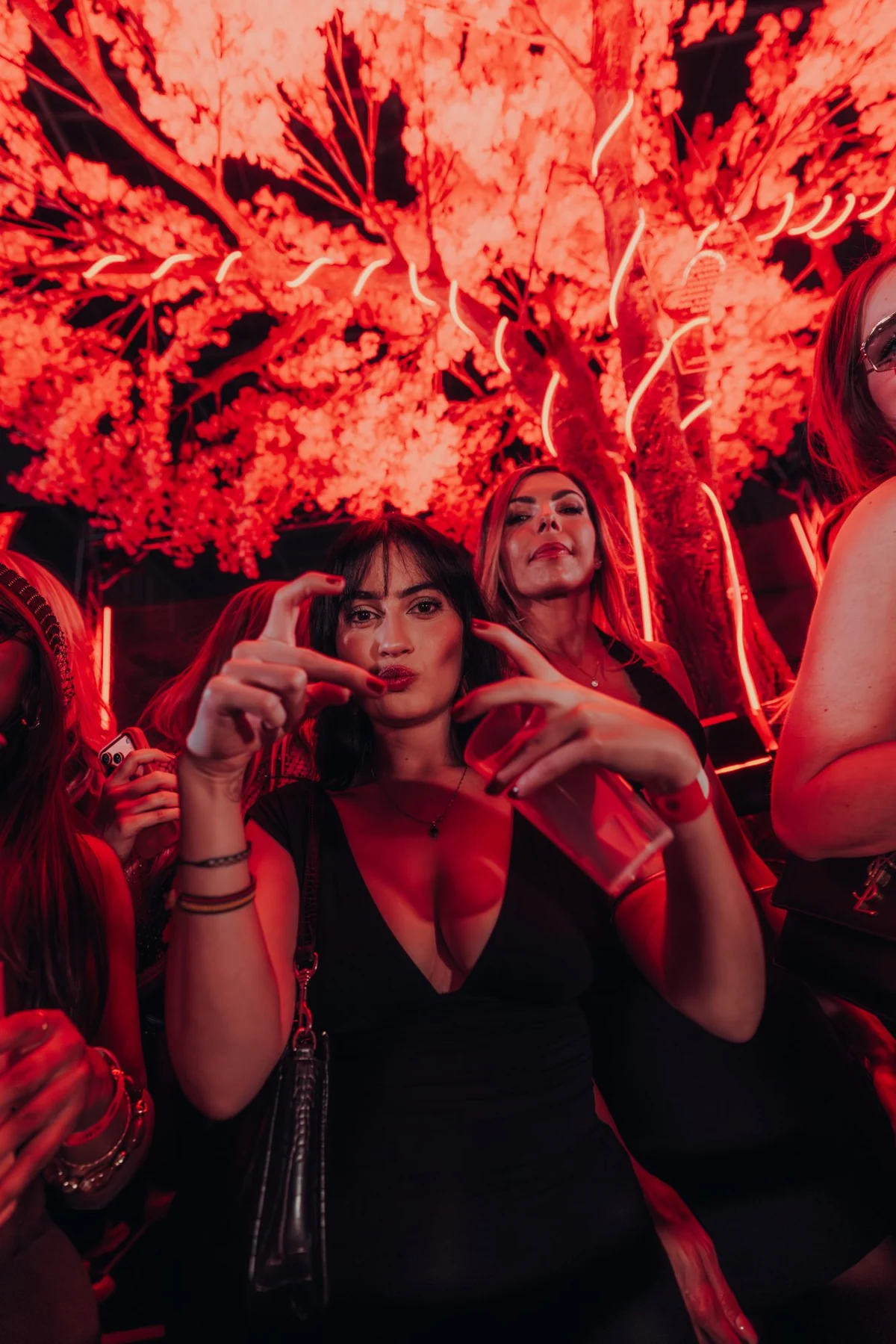
On Saturday, the Red Tree stands in Berlin for the first time, in the courtyard of Roomers on Steinplatz. Party from 9 pm, and at midnight the tree turns blood red. Earplugs fit in any bag, even the smallest one next to your lipstick. Everything about the night is on the event page, and what to wear is in our Halloween guide. Back in Frankfurt after Berlin? Our picks are in the Frankfurt guide.
Where the tree goes after Berlin, the Red Tree Family hears first.
Sources
- Ramakers et al.: Effectiveness of Earplugs in Preventing Recreational Noise-Induced Hearing Loss, JAMA Otolaryngology 2016 (PubMed)
- Bayerischer Landtag: Drucksache 16/8996, Prävention von Hörschäden bei Jugendlichen (2011)
- LGL Bayern: Messprogramm Schallpegel in Diskotheken (abgerufen 27.10.2026)
- WHO: WHO hearing guidelines implemented at major arts festival (08.10.2024)
- Barmer: Tinnitus und Ohrgeräusche (abgerufen 27.10.2026)
- CDC/NIOSH: How to Wear Soft Foam Earplugs (abgerufen 27.10.2026)