

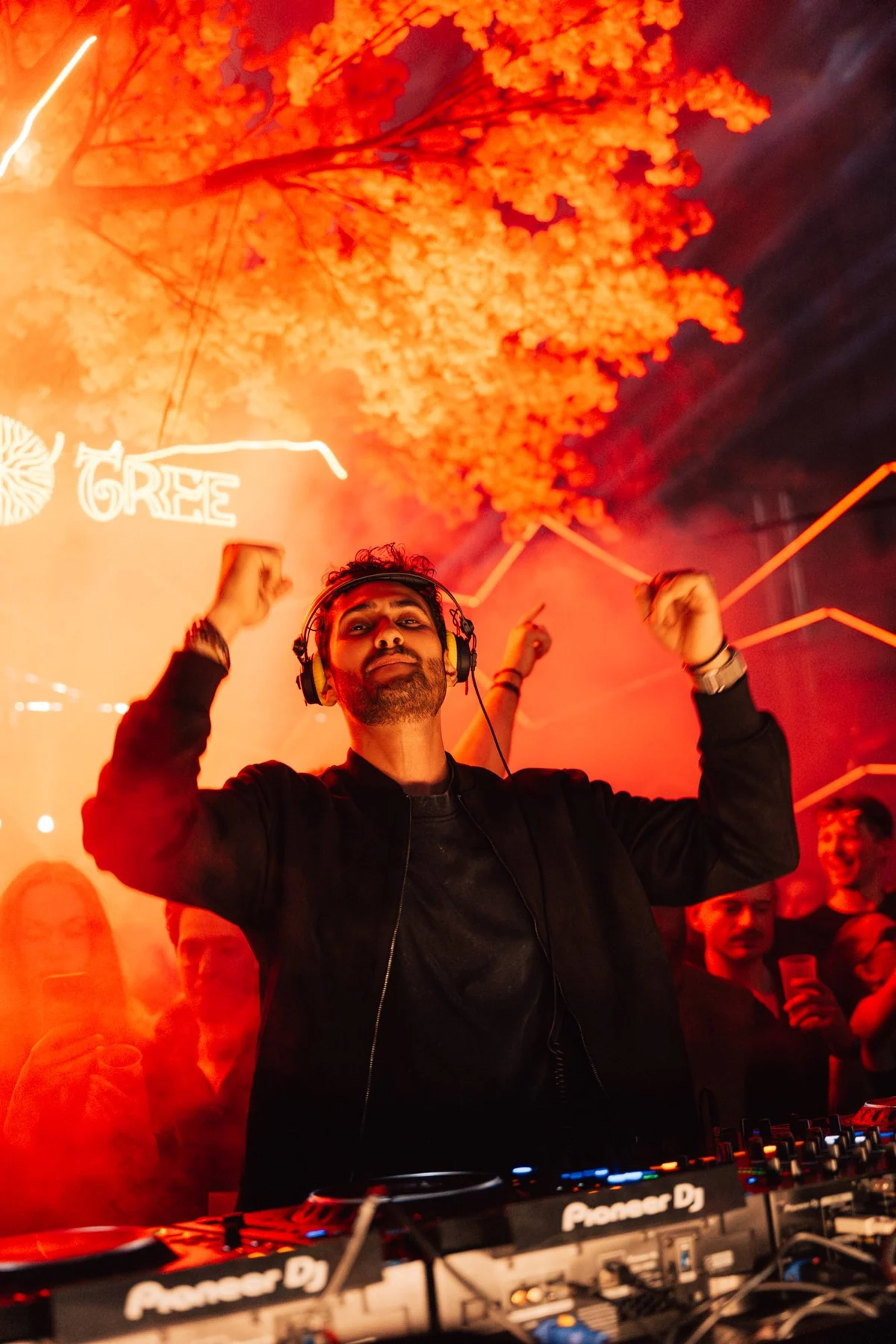
At Red Tree these styles often run side by side in one night, and on the floor you barely notice where one ends and the next begins. Still, each has its own roots and its own sound. Here is the overview, no music theory needed.
Deep house
Origins: Deep house has its roots in the house music of Chicago and New York. Larry Heard is seen as one of its pioneers. A lot of what we call melodic or organic house today grew out of it.
The sound: Warm, calm and groovy, often with jazzy chords, soft basslines and vocals that sit in the mix rather than up front.
Works for: the first hours of a night and anyone who would rather groove than jump.
Melodic house
Origins: Melodic house grew out of deep house and progressive house. Beatport files it under a shared Melodic House & Techno category, because the line to melodic techno is fluid.
The sound: Synthesizers lead. Long pads, emotional harmonies, arpeggios and tension that builds over several minutes before it opens up in one big moment. The mood is often melancholic and epic at the same time.
Names to check out: Tale Of Us and their label Afterlife, Lane 8 with This Never Happened, Kevin de Vries.
Right now: In its 2026 mid-year review, Beatport says the genre keeps pushing further into bigger rooms.
Organic house
Origins: Organic house is the youngest label on this list. Music with these traits was already around by 2017, for example in the Burning Man scene. Beatport officially introduced the term in June 2020.
The sound: Warm, calm, almost meditative. Acoustic instruments such as kalimba, violin or vibraphone, natural sounds and soft, drum-based percussion. Organic house is usually a little slower than the other styles and works well at sunset or early in the night.
Names to check out: Lee Burridge and his label All Day I Dream, Sébastien Léger, Oliver Koletzki, and labels such as Cafe De Anatolia and Songuara.
Techno
Origins: Techno comes from Detroit in the mid-1980s. In Germany it took off above all in Berlin and Frankfurt, and Frankfurt was long known as a techno capital.
The sound: More straightforward, harder and more repetitive than house. The kick lands on every beat, melodies are sparse, and it is all about drive and tracks that will not let go of you. Techno is usually faster than house.
Works for: the late hours, when the hall is packed and things should step up again.
Right now: According to Splice's "Sounds of 2026" report, hard techno sample downloads grew by triple digits in 2025.
The differences at a glance
- Deep house: warm and jazzy, the groove comes first
- Melodic house: synths and long builds, the melody comes first
- Organic house: acoustic instruments and natural sounds, relaxed tempo
- Techno: straight kick, more drive, less melody
So where does Afro House fit in?
Afro House is its own style with roots in South Africa, where percussion and vocals call the shots. Splice named it the sound of 2026. It is closely related to organic house, and plenty of organic tracks use similar drums. For us, Afro House is more of a colour that shows up in a set now and then than the theme of a night.
Why the lines blur
In practice, these styles overlap. Organic house is often described as a blend of deep house, melodic house, electronica and Afro House, and Beatport even groups melodic house and techno in one category. A good set makes the most of that: it starts warm, gets denser over time and eventually lands in techno. Splice also predicts that organic and acoustic elements will matter more in 2026.
And tech house?
Tech house is drier, heavier on the bass and built for the floor. According to the IMS Business Report 2026, it has been Beatport's best-selling genre for the third year running.
How to tell them apart on the floor
Notice what is moving you. If you are swaying and listening to the chords, it is usually deep house. If your eyes are closed and you are waiting for the next break, it is melodic house. If you would rather just stand and listen, it is probably organic house. And if the kick is pushing you forward and nobody is talking anymore, you have arrived at techno.
Questions and answers
What is the difference between deep house and melodic house?
What is organic house?
Is melodic house techno?
Sources
- Organic house (Wikipedia) · 2026-10-14
- Afro house (Wikipedia) · 2026-10-14
- Sounds of 2026: MIDiA and Splice name Afro house as the sound of the year · 2026-01-13
- Splice x MIDiA Sounds of 2026 Report (RouteNote) · 2026-01-15
- The Top-Selling Tracks, Artists, and Labels of 2026 (Mid-Year Review), Beatportal · 2026-06-29
- Electronic music industry grew to $15.1 billion in 2025 (MusicTech) · 2026-04-22
- Einstige Techno-Hauptstadt Frankfurt (hessenschau) · 2026-03-18